Showing posts with label Baccharis neglecta. Show all posts

Thursday, October 13, 2016

Monarchs at HNWR Now

Monarchs on Frostweed in butterfly Garden, by Bill Powell

Monarch butterflies are taking center stage at Hagerman National Wildlife Refuge these days as large numbers are seen nectaring, "fattening" up as they journey to Mexico for the winter.  Photographers are having a field day in the Butterfly Garden, which is living up to its designation as a Monarch Waystation,  finding monarchs galore on the Frostweed and Baccharis planted there and blooming just in time for the migration.  North American monarchs are the only butterflies that make such a  journey, which the World Wildlife Federation describes as:

... a marvelous migratory phenomenon. They travel between 1,200 and 2,800 miles or more from the United States and Canada to central Mexican forests. There the butterflies hibernate in the mountain forests, where a less extreme climate provides them a better chance to survive.
Also from WWF,
The monarch butterfly is known by scientists as Danaus plexippus, which in Greek literally means "sleepy transformation." The name evokes the species' ability to hibernate and metamorphize.
From National Geographic:

Butterflies that emerge from chrysalides (pupa state) in late summer and early fall are different from those that do so during the longer days and warmer weather of summer. These monarchs are born to fly, and know because of the changing weather that they must prepare for their lengthy journey.
Only monarchs born in late summer or early fall make the migration, and they make only one round trip. By the time next year's winter migration begins, several summer generations will have lived and died and it will be last year's migrators' great grandchildren that make the trip. Yet somehow these new generations know the way, and follow the same routes their ancestors took—sometimes even returning to the same tree.
Many scientists are concerned about the eastern population of monarchs, which summer east of the Rocky Mountains. This group is occurring in ever smaller numbers, and its survival may be threatened by a series of natural disasters in the Mexican wintering grounds, as well as by reduced acreage of milkweed plants in their summer home.

Thursday, November 13, 2014

What is Baccharis

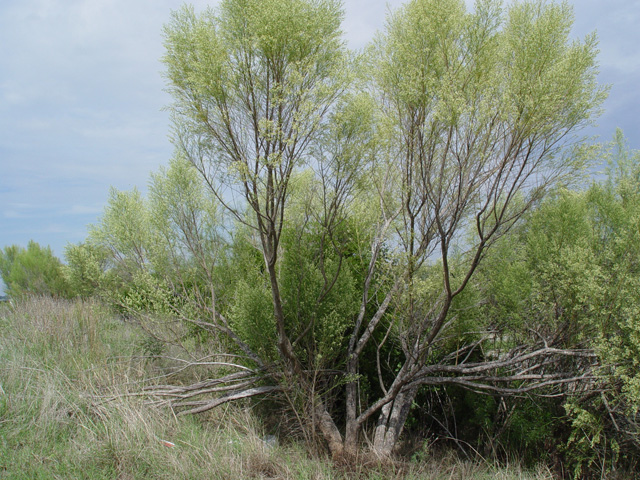
Recently there has been lots of conversation at the Refuge about Baccharis, but what is it?   Growing in profusion along many of the Pad roads, this plant provided a roosting spot for many migrating monarchs this fall.   We consulted Dr. George Diggs about which species of Baccharis we are seeing.  Dr. Diggs said that the Baccharis we are seeing is most probably Baccharis neglecta Britton.  He added, “While I haven’t collected B. halimifolia at the refuge, it is definitely in the area (known from both Dallas and Fannin counties) and I suspect it has moved into Grayson County by now.”  Both are native to the lower 48 states.

According to the Lady Bird Johnson Wildflower Center, UT, Baccharis neglecta Britton, which is also known as False Willow, Jara dulce, Poverty Weed, Roosevelt Weed, is “A weedy, tall (6 -12’) shrub abundant in fields out of cultivation and on disturbed ground, also in unshaded, low places. With ascending light brown branches and green twigs. Leaves partly evergreen, very narrow, less than 1/4 inch wide and up to 3 inches long. Male and female flowers on separate plants. Female flowers inconspicuous, silky, in small, greenish white heads which appear to be individual flowers, these arranged in large clusters up to 1 foot or more long and 8 inches wide, resembling silky plumes in October and November. Fruit, minute, about 1/16 inch long, borne on the wind by a tuft of hairs."


Baccharis neglecta (Photos by Melody Lytle, from  Wildflower Center Digital Library)
Baccharis, along Pad C at HNWR, by William H. Powell

The website notes that Baccharis is the ancient Greek name (derived from the god Bacchus) of a plant with fragrant roots, and the species name neglecta refers to the prevalence of this plant in neglected or disturbed areas.  The shrub offers a showy profusion of silky silver/white flowers, and is also a good nectar plant for many pollinators including some butterflies.   Luckily for the butterflies, the plant is highly deer resistant, too! 

Alternatively, Baccharis halimifolia, which is also known as  Groundseltree, Sea-myrtle, Consumptionweed, Eastern baccharis, Groundsel, Groundsel bush, Salt marsh-elder, Salt bush, Florida groundsel bush is also a 6 – 12 foot deciduous shrub which is tolerant of salt-water spray.  Its plumes in fall are said to resemble “silvery paintbrushes.”