Showing posts with label Great Blue Heron. Show all posts

Thursday, April 11, 2013

Great Blue Heron Rookery at Refuge

Great Blue at Hagerman NWR by Carol Ann Sowell


The Great Blue, a favorite sight year around at HagermanNational Wildlife Refuge, makes its nest in a group of the tallest trees on the horizon, looking south from the Harris Creek Bridge.  
Heron Rookery

The Herons, members of the Ardeid family, are seasonally monogamous, according to (Sibley, 2001) The Sibley Guide to Bird Life & Behavior, and breed in colonies.
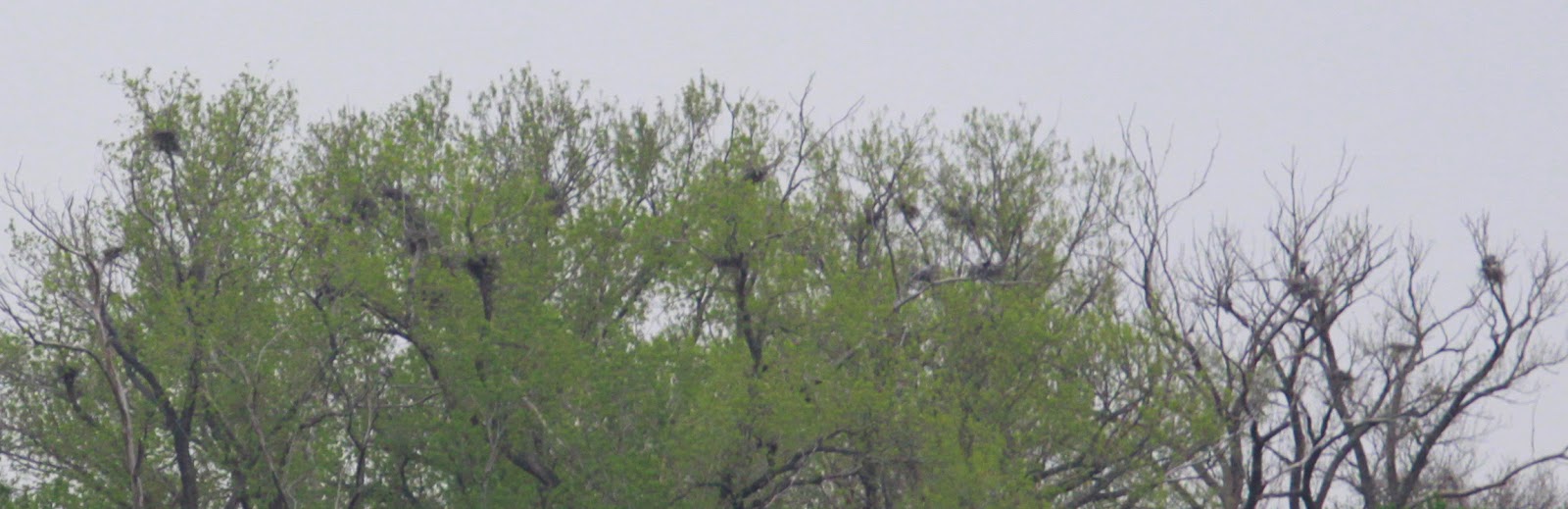
The male and female cooperate in building the nest, which is usually located near water.  In colonies with mixed species, they tend to nest in tall trees, and may reuse the nests from one year to the next, adding on or refurbishing.

Herons have a single one brood each year, with from 2 – 7 eggs.  Parents take turns incubating which usually begins as soon as the first egg or two are laid.  When the chicks hatch they may be different sizes due to varied time under incubation.
The chicks, who make continuous food-begging calls, (Sibley, 2001)are fed by the parents, who regurgitate it into their mouth or onto the nest.  By two weeks in age moat chicks are ready to leave the nest and perch nearby.


If you visit the Refuge soon, be sure to look for the rookery as you cross Harris Creek Bridge.

NOTE:  David Sibley will be at Hagerman NWR for BirdFest Texoma.  He will present a painting demonstration at Evening with David Allen Sibley, and the painting, A Painted Bunting, will be up for auction at the close of the evening; register for this event at birdfesttexoma.org (no tickets will be sold at the door).  Sibley will also sign books from 11 am - Noon at the Refuge, May 4, and following the evening presentation.

Photos of  Rookery by Dick Malnory

Thursday, May 19, 2011

The Great Blue Heron


One of the most easily recognized and photogenic birds in America can be seen every day of the year at Hagerman. The largest member of the heron family, the great blue heron stands four feet tall and has a six foot wingspan. The name is misleading. Rather than blue it is largely gray with a long yellow-orange bill, yellow eyes, long pale legs and black occipital patches separated by a white stripe. The underside of the neck is white with black and brown hatching.

The great blue is solitary most of the time except when roosting or breeding. Its diet is mainly fish, frogs, snakes and other marine life. While foraging it slowly stalks its prey. It may remain motionless for minutes before suddenly striking with its long uncoiled neck. Small fish are grasped in the bill and large ones are impaled. They are then tossed in the air and swallowed headfirst. Great blues tuck their heads close to their chest in flight, making them easy to identify.

As the days lengthen early in the year light penetrates the skull stimulating hormone production. This initiates migration and breeding. In the south some birds do not migrate. Hormonal changes produce remarkable physical changes. The most obvious marker is a bright electric blue skin patch between the eye and bill in a location called the lores. The legs become salmon colored and tha crown feathers are elongated. The male is about ten percent larger than the female. Otherwise both sexes appear identical. Courtship is initiated by the male who finds an old nest or builds a new one and stands by it engaging in a series of stretches called displays. His new mate will reciprocate with displays signalling her acceptance of his overtures. She then proceeds to rebuild the nest to her specifications with his help. When this chore is completed more mutual displaying occurs followed by copulation. The clutch usually consists of four eggs. The eggs are hatched after four weeks of incubation.

Both parents share the responsibilities of incubating, catching food and feeding the chicks by regurgitating partially digested fish. As the chicks mature the competion for food becomes violent. The youngest and therefore the weakest chicks often die from starvation or fratricide. By eight weeks when the chicks are almost as big as their parents and ready to fledge. By the end of the first year less than half will have survived.

The greatest concern for the future of all birds is the unremitting habitat destruction due the explosive human population growth. The world’s population in 1930 was two billion. By 2011 it was up to seven billion with a projection of nine billion in 2030. The ramifications of these changes should be obvious.

Text and photo by Phil McGuire

For more information about Hagerman National Wildlife Refuge, see the official site, http://www.fws.gov/southwest/refuges/texas/hagerman/index.html and for information about the Friends, see http://www.friendsofhagerman.com.

Monday, May 31, 2010

A Day at the Refuge


By Nancy Miller

I go to the refuge almost every weekend to take pictures, because that is what I like to do. I know there have been many times I have said or thought, “I haven’t seen much today”, and a Saturday a couple of weeks ago was one of those days. So I made my rounds to head home. As I was going up and down the roads, I realized how wrong I was. I may not have seen some of the new species of birds that have arrived at the refuge, but I had seen a lot.

First of all, I saw friends I have made coming to the refuge. I went on a hike toward Deaver Pond with a friend, and I saw several species of butterflies, dragonflies, and even some damselflies. Another thing that caught my eye was a spider crawling around on the web it had woven around some flowers. I took several pictures of this, I find it fascinating - their webs are like a piece of art. The web was woven completely around a batch of flowers.

I mustn’t leave out all the different varieties of wildflowers growing everywhere! All the colors are just beautiful. One of my favorites is Indian Blanket or “Firewheel”. The vibrant orange/red center with yellow tips, I can’t resist getting a picture of one or two every time I get out. The Bee Balms are also beautiful, along with the bright yellow Cone Flowers that are very plentiful. There are all kinds of little insects enjoying these flowers, if you really look at them as you pass by.

The baby geese have really grown in the last few weeks. I watched them as they crossed the road, all in a row. I pulled in the middle of the road to make sure no one came around me and hit any of them. Of course I saw Egrets, Snowy Egrets, and a Great Blue Heron, which are always fun to watch. Even though I have dozens of pictures of them, it is always a pleasure to see them. I saw sparrows and other small birds. I saw Red-wing Blackbirds chasing after some Crows, which was pretty amusing to watch the bigger bird trying to get away from the smaller birds. You see some pretty amazing things at the refuge if you take the time to look.

Ed. Note: Hagerman National Wildlife Refuge is open daily from dawn to dusk. There is no charge for admission. The Refuge Headquarters is open for business Monday - Friday, 7:30 a.m. - 4 p.m., holidays excepted. The Headquarters is also open to visitors, thanks to volunteers, on Saturdays, 9 a.m. - 3 p.m., and Sundays 1 - 4 p.m., and reduced hours on holidays other than Thanksgiving and Christmas. For more Refuge information, see http://www.fws.gov/southwest/refuges/texas/hagerman/index.html see http://www.friendsofhagerman.com.

Monday, March 1, 2010

Signs of Spring


By Laurie Sheppard


I hate winter!! That's one of the the reasons I like living in North Texas - spring comes early here. Just about the time the holidays are over, I start looking for a change in the seasons. I'm ready to give up the long dark nights and enjoy late sunsets instead. Despite recent snowstorms, I'm optimistic that warmer weather is right around the corner. No, my redbud tree is not in bloom yet and the mercury has not emerged from the depths of the fifties, but I do see signs of spring everywhere.


Driving to the Refuge, I love to look out over the autumn planted fields and see a brilliant emerald carpet. Even along the roadside, there are sprouts of fresh green grass, and I know before long I'll see blossoms on Bradford Pear trees in yards along the way. One of the olfactory signs of spring struck me as I was driving home from the Friends board meeting at the Refuge last Thursday night. In spring, skunks become more active and occasionally one wanders onto the highway and the inevitable occurs.


Another sure sign of spring is the changes in the birds. You can hear it and see it at Hagerman. Cardinals and others call loudly from treetops to attract a mate. Yellow-rumped Warblers can be seen courting - they fly out from a bush or tree and flit about before returning to the same perch, almost as if they are saying "Look at me!"


Last year's babies who looked so much like their mothers all winter are starting to come into their adult plumage. Young male Red-winged Blackbirds are shedding their brown feathers and bursting out in shiny black with brilliant yellow and red shoulders. They're gathering in groups and trying out their grownup voices. Great Blue Herons with dull grey heads are suddenly sprouting distinctive black and white, and adolescent Northern Shovelers look bedraggled, caught in between juvenile and adult feather.

New birds are arriving here everyday - I know it's spring when House Finches show up at my feeding station to compete with the House Sparrows and Dark-eyed Juncos. Chipping Sparrows scratch around in winter-moist soil for new sprouts and overlooked seeds. More and more shorebirds arrive at Hagerman as the Snow and Ross's Geese gather for their return trip north.

Now, where are those Redbuds?

Visit the Refuge soon to see these signs of spring for yourself. For more information, see http://www.friendsofhagerman.com.


Photos - Adolescent Shovelers, and Chipping Sparrow - by Laurie Sheppard


Monday, January 4, 2010

Great Blue Rescued through Team Effort


By Jana Singletary


Saturday, January 2, 2010 - Phil and I took Braden, age 5, to Denison Dam today in search of Eagles. Instead we were shocked and saddened to find a Great Blue Heron in a very desperate situation. It had been snagged by several lures on a fishing line that dangled down from a power line over the river. We watched in horror as the heron struggled unsuccessfully to free himself.
As we watched, a fisherman kept throwing rocks in an attempt to break the line. To our amazement, the line finally snapped, and the bird plunged into the river. It managed to swim to shore, but it was obvious that it was badly injured. The fisherman attempted to get close enough to help the bird but quit when he saw that the bird was becoming more stressed by his efforts.
I called my daughter Kim, who located a wildlife rehab organization in Dallas. After some good advice from them and volunteers Michael and Grace Haight at Hagerman NWR, I contacted a local expert, Steve Armstrong, Grayson County Wildlife Rehabilitation, who quickly rescued the injured heron and transported it to a rehab facility. Hopefully they'll be able to save the bird. It was the best possible ending to a very stressful day.


Photo of Great Blue Heron taken by Becky Goodman at Hagerman NWR.

Editors Note: This episode underlines the importance of taking lines and lures home, not leaving them to snare or hook waterfowl and other creatures. Metal can tabs and the plastic loops that hold six-packs are other common hazards to wildlife. Please, please, pay attention to the adage, in nature, leave behind nothing but your footprints!


A source of information re injured wildlife is http://www.dfwwildlife.org/. For more information about Hagerman NWR see http://www.fws.gov/southwest/refuges/texas/hagerman/index.html, and for information about programs and activities at the Refuge, see http://www.friendsofhagerman.com.